Slider

Overview

November 13, 2016


"capture and share the world's moments"

In our exploration of the inherent inauthenticity or authenticity of social media, we aim to gather a series of qualitative data that explores if and how social media, as both a platform representative of a larger institutional structure and personal sharing device, inhibits or promotes authentic representation of self. We understand that the term “authenticity” is often a broad and abstracted concept that correlates to an imagined state of “core” personal characteristics and values. We will add pressure to this definition in order to reconceptualize the idea of authenticity to the idea of completion. In what ways is an authentic self, in the context of social media, a complete self? Our research is primarily interview-based, utilizing both narrative and phenomenological data to explore this question of how Instagram, the company, may engage in a process of self-branding to coherence their audience into believing in the representative power of social media as a complete image of self. Possible limitations to our research reside in the lack of quantitative data. But, as this project is fairly limited to a specific timeline, we wanted to focus our energy on the exploration of Instagram through narration, as we found it to be a more powerful voice for conceptualizing the often abstracted media theory in a more personal context.

does social media inhibit authenticity?


About Us


We, as curators of this website but also curators of our own Instagram accounts, will now engage with the platform. We will explore our own pages, critical analyzing the ways in which we create our own “content” and communicate our own, either intended or unintended, message. This component of our website ensures that we are asking ourselves to engage with Instagram in the same way we ask our interviewees too. We will each explore Instagram from a different critical angle, given our own experiences with the platform.


Meg DeMarsh @megdemarsh


I would like to start off by talking about how I personally use Instagram and my intentions for the platform. I don’t love social media, but I do love scrapbooks. And I think this is the primary reason why I love this platform. My page is a digital scrapbook. It combines the people I love and the places I’ve been to create a digital repository of my life (which I’m sure the “higher-ups” of Instagram would love to hear). But I also understand that although I intend to use the platform as a vehicle of remembrance, my mere engagement with Instagram places me in the debate of how I represent myself online.


As I was scrolling through my page, I realized that my pictures, although I posted them as ways of collecting and I suppose inherently “publicizing” the people that I love, could be read as being fairly “basic.” What do I mean by “basic?” Terminology such as this originated in the era of increased social media usage.


I am interested in how Instagram operates as a mechanism to connect with other people but how this process of externalization may ironically lead to self-depletion/distortion.


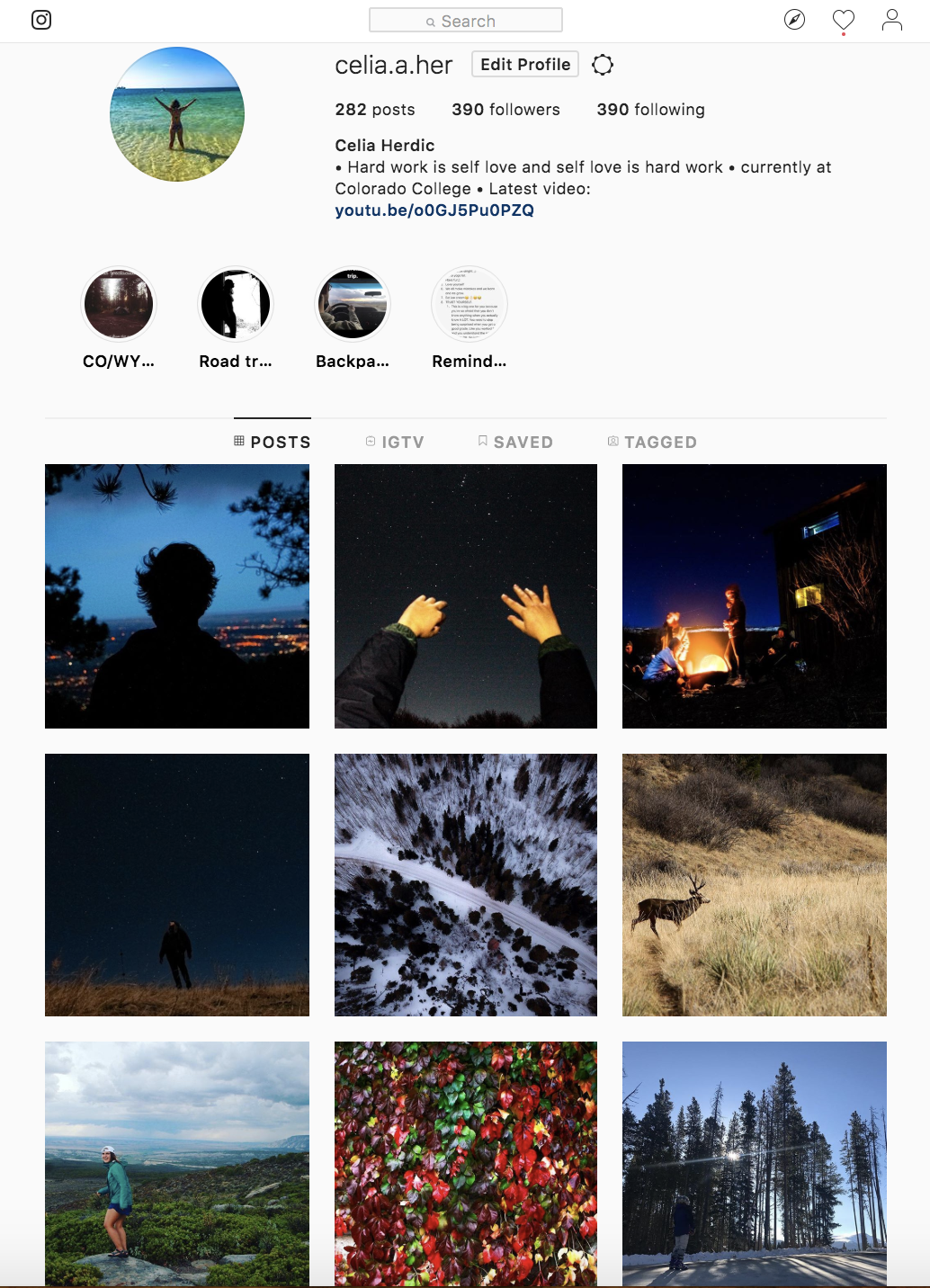
Celia Herdic @celia.a.her


I got instagram in high school our of peer pressure. I was the only one out of my friends who didn’t have an instagram so I could never get tagged in pictures whenever we took pictures together. Because I didn’t have any online presence, it was as though I didn’t exist and it felt as though I had to catch up with the rest of the world.


Once I got it, my friends told me ‘the rules’ of instagram-- the unspoken rules of instagram. 1. Don’t post two times on the same day. 2. Don’t do two selfies right next to each other. 3. Don’t make your captions too long. 3. You should follow people back if you know them, if you don’t it’s offensive (and the list goes on).


Immediately when I encountered these ‘rules’, I knew I was not going to do it. It felt fake and it felt like too much to keep up with so I used it differently. I used it as an opportunity to show things that I thought were pretty. Whether it was a flower or a sunset or whatever, I took time out of my day to acknowledge it through a pictures and even though I probably didn’t even get 10 likes it was good enough for me. As time went on, I began to post more pictures and my interest in photography really developed and it became a daily thing of posting and editing a picture. As this passion developed, so did my captions. I talked about things that have been on my mind or quotes that have really stuck out to me. I manifested my page as a space for vulnerability and reflection and posting became a therapeutic practice for me.


As time went on and I got more followers people would always come up to me and be like “Celia, I love your instagram!”. Although I did definitely take it as a compliment, it also materialized the idea of people watching me. Before when I didn’t have many followers, I didn’t really think about what I posted, but as more followers came I found myself thinking more and more about who sees my content. Additionally, thoughts came about personal branding. I found myself subconsciously branding myself and although this brand I created for myself felt authentic, it also felt strange because this instagram is only ONE angle to me and sometimes I wondered and still wonder if people understand that.


In the past, I would post every single day (crazy right?!) but now, I find myself only posting occasionally, when I especially feel like it. I love going through my old pictures from when I was abroad and reflecting on my past experiences. Although Instagram has its downfalls, it is a great way to preserve past experiences, thoughts, and ideas to see how one has changed over time and this platform has definitely done that for me.


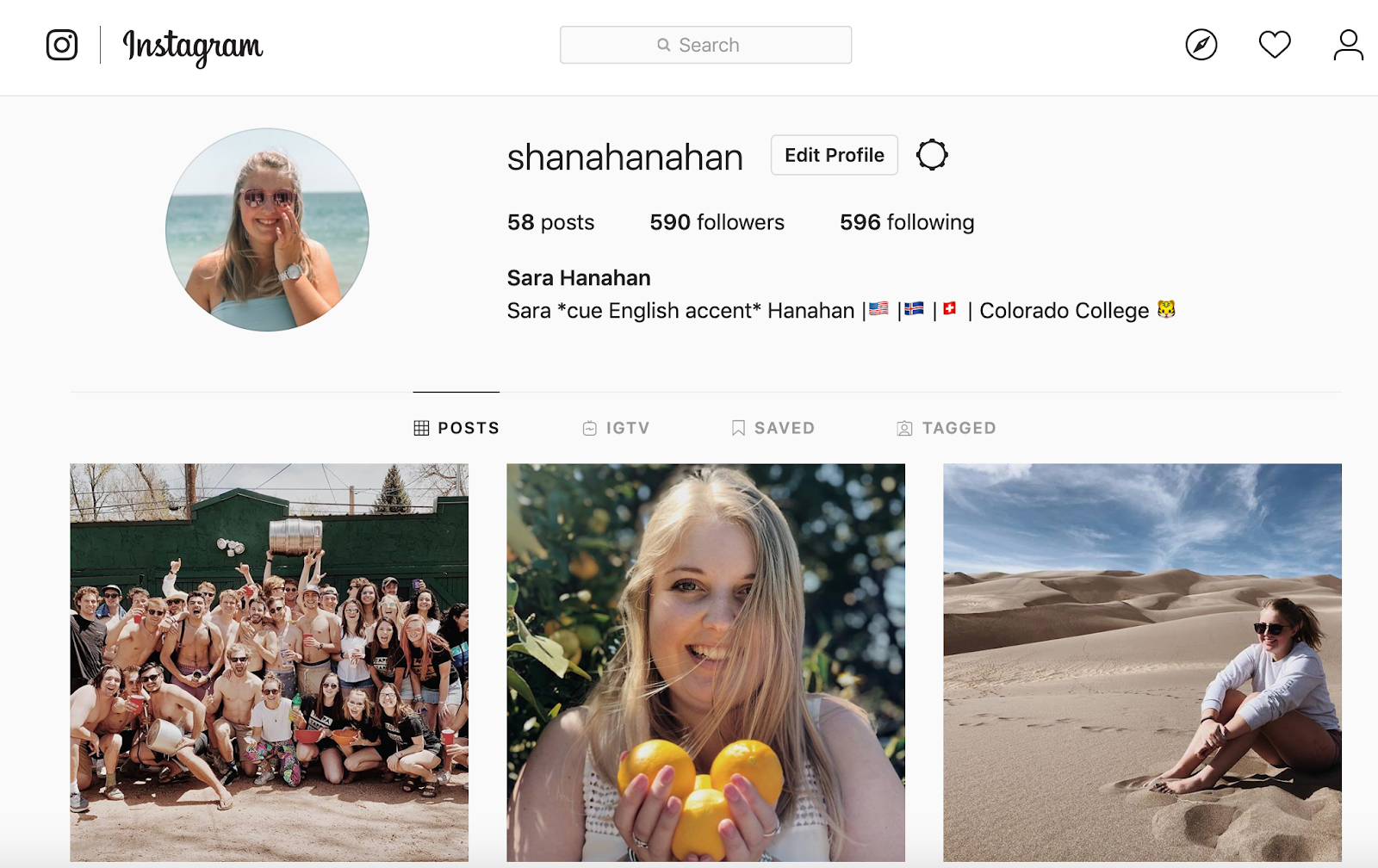
Sara Hanahan @shanahanahan
I feel that Instagram is a platform that changes so much with time and cannot be defined in its ways because of this. I joined the Instagram community approximately 6 years ago, when I was a freshman in high school. At the time I joined, I never thought too much about what I posted. If I liked a picture, I would post it. It was as simple as that. The first few pictures I posted were very wholesome and representative of myself and the people whom I chose to surround myself with. I would post both photos I liked but also moments I loved.
However, the longer I had the app; I started to understand the way I was “supposed” to use Instagram. I then started posting photos from special events, when I was composed, having a good time, and I wasn’t doing anything dumb. I then went through a phase where everything on my feed had a blue element in it, making my feed more “aesthetically pleasing.” I then moved on to a more retro theme, which seemed to make my feed look like I was having more fun, was always happy, and was constantly travelling (rather than studying). I was never intending to create a false perception of my life via my Instagram profile. I just rather became more critical of the photos I was in, and what I wanted other people to see, what part of myself I wanted everyone to see, and somehow, what I post is what I felt was the best representative of this.


Profiles


The primary purpose of the profile component, being written interviews, and video component, being recorded interviews, of our research is to engage with both the narrative and phenomenological understanding of Instagram as a cultural and personal force of representation. The contrast between the profile, as written, and the video, as recorded, will further illustrate the different forms, and limitations, of representing who people are on the Internet.


Anonymous

This person is a young entrepreneur who is a cofounder of two businesses. Their profile shows his best moments, while also finding a way to integrate their businesses into it without being too obnoxious about it. This person has posted 156 pictures, follows 609 people, and has a shocking 33.7 thousand followers.

What kind of people are your close friends/family and how would they describe you?
First and foremost, I aim to surround myself with positivity above all else. This isn’t an everyday thing, people have good and bad days, but the people who I believe are intrinsically positive.
The second factor for me is intelligence. I try to surround myself with people who are smarter than myself in various fields. While I’d consider myself pretty smart, I can’t be at everything, thus, I try to make sure the people around me are smart in what I am weak in.
The third factor for me is whether they are intrinsically good. Again, people have moments of weakness where they say mean things, judge, etc. but I surround myself with people who seek the good in people the majority of the time, and who I view to be good internally.
As for how they’d describe me, I think they’d say I try hard. I make large strides to be good, positive, and intelligent, and often fall short, but I think my friends and family recognize how hard I try to be those things. The key phrase I think they’d use would be hard working.
How would you describe your personality and self on Instagram? / How do you brand yourself on social media?
I portray the best moments of my life on Instagram, thus I would say my personality is positive, motivated, and happy. I brand myself as an entrepreneur on social media.
Can you talk us through your page? Is there a certain aesthetic or vibe you are curating through your page?
I like for my page to have wide appeal, thus, I never curse in social media posts, as I want kids to be able to follow me, I rarely post about friends, as I want people who have few to feel motivated. The aesthetic I go for is quality. I don’t, or rarely, post dark or blurry pictures because I myself don’t like when others do, so I don’t. The vibe I go for is a positive vibe, happy times. In my opinion, there is so much negativity out there that I don’t want to put that out there on social media.
How would you describe your Instagram personality versus how people close to you view you?
I think people would align the two together fairly closely. However, that’s “people”. If you were to ask friends, I think they’d say it poorly depicts the entirety of my life, as it only shows the good times, and just like everyone else, my life has plenty of bad times.
Do you believe that your Instagram shows a COMPLETE picture of yourself or does it just show a specific portion of yourself?
Only shows the positive sides.
Do you think that it is possible to show a COMPLETE picture of yourself and life on this platform? Why?
Not really, because nobody can get into your head, and I think the majority of one’s life is lived in their head. Theoretically, you could post how something someone said affected you, but they’d never be able to feel it the way you did, thus, you’ll never be able to put out a complete picture.
Is Instagram inauthentic?
No, there’s a lot I don’t like about Instagram, but there’s a lot I do. I don’t think it’s inauthentic, because even if you’re pretending to be someone who you currently aren’t, it might be because you’re striving or working to be that person. When you look good, you feel good, I believe that strongly.
What do likes mean? What do followers mean?
Nothing, they’re a metric for nothing. I think they’re the most damaging part of Instagram. Assigning a metric to give you validation can be painful and it’s an endless chase, I hate it. 


People


We have already interviewed on subjects on camera. As with our profiles, we were very intentional
in selecting our subjects. The “messages” each interviewee articulates can be explained to the following: Instagram as a design platform, Instagram as personal branding and company-based representation, Instagram as social connection, and lack of Instagram usage. This diversity of purpose behind the social media platform provides articulate, introspective, and perhaps most importantly diverse understandings of how the platform operates in a person’s day to day life. 


Reflection


The critical analysis component of our website conceptualizes our interviews in the context of the class readings, as indicated in the citation component of our outline. Again, we hope to answer or at least explore how social media, and specifically Instagram, inhibits or promotes authenticity and self-completion online.

Latest Instagrams

© People vs. Profiles . Design by Fearne.